Copenhagen-based DR Sales, the international distributor of Oscar-winning doc “Mr Nobody Against Putin” and Sundance winner “A New Kind of Wilderness,” has boarded Denmark’s “Father’s House,” starring David Dencik (“No Time to Die,” “The Chestnut Man”) and Trine Dyrholm (“The Danish Woman,” “Queen of Hearts”). Selected for the Tallinn Black Nights Film Festival international documentary
Copenhagen-based DR Sales, the international distributor of Oscar-winning doc “Mr Nobody Against Putin” and Sundance winner “A New Kind of Wilderness,” has boarded Denmark’s “Father’s House,” starring David Dencik (“No Time to Die,” “The Chestnut Man”) and Trine Dyrholm (“The Danish Woman,” “Queen of Hearts”).
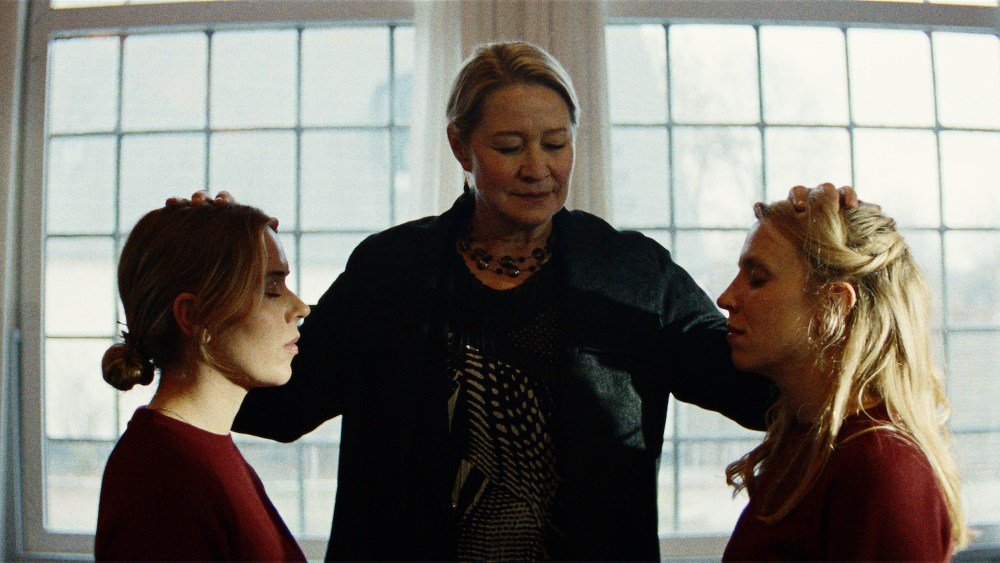
Selected for the Tallinn Black Nights Film Festival international documentary competition and IDFA’s Signed section, “Father’s House” sees Dencik and Dyrholm acting in the reenactment scenes of a film which homes in on manipulation in a religious sect.
“Father’s House” is co-directed by multi-awarded doc specialists Andreas Koefoed (“The Lost Leonardo,” “Music for Black Pigeons”), Eva Mulvad (“Enemies of Happiness,” “The Good Life”) and editor Adam Nielsen (“The Investigation,” “The Letter Room”).
“We have been very excited about this project for some time. Once we saw the first cut, we were all blown away by how powerful and original the film is,” said DR Sales Executive Producer Kim Christiansen.
A distinctive mix of fiction, documentary and making off, “Father’s House” (“Faderhuset”) looks at manipulation, abuse and often violence inside the radical Danish Christian sect Faderhuset, as three former members expose the inner workings of the now defunct sect where exorcism and speaking in tongues and militant Christianity were, reportedly, part of everyday life.
Defining moments in the lives of the three characters within that closed sect are brought back to life via reenactments from established actors, under the guidance of the real former members.
In a meta exercise. Dyrholm plays the charismatic leader Ruth Evensen (now Ruth Kristiansen) who led Fathers House since the 1990s until its official closure as a religious congregation in 2013. Dencik is the former member Jerry and Laura Kronborg Kjær (“A Fortunate Man,” “When the Sun Shines”) Camilla who stayed seven years within Father’s House before breaking away and setting up the NGO-InsideOut to help people leave such sectarian communities.
Why Bring in Trine Dyrholm and David Dencik?
Mulvad told Variety that the starting point to the film was a book written by former member Camilla Louise Johnson which sparked her interest in “cults, group dynamics and why people in a free world long to belong,” to the extent of surrendering their own lives.
Depicted by Mulvad as “an important gatekeeper” throughout the filmmaking process, Camilla then introduced the directors to other former members of the sect who “shared their experience in a generous way” and contributed to the script.
To avoid getting into “the long and lonely process of being a documentary director,” Mulvad rallied to her idea Koefoed, once the film’s hybrid concept was in place.
“I found it very original and playful, and it gave me the opportunity to work in a new way,” said the helmer of the Tribeca-selected Sony Classics release “The Lost Leonardo.”
Nielsen who had edited Mulvad’s Karlovy Vary winning doc “The Good Life” and Koefoed’s acclaimed “The Arms Drop,” joined, enjoying his first directing gig. “I was basically the rug from “The Big Lebowski” – the one tying the room together,” he quipped, before admitting: “It definitely gave me a taste for [directing].
Quizzed about their choice to mix fiction and documentary, the co-helmers said, “What interested us most were the bizarre, insider stories from Father’s House. However, since no footage of those moments existed, we knew we didn’t want to rely on a traditional, interview-driven documentary. At the same time, we wanted to avoid a standard fiction film that forces real human experiences into a rigid plot. We wanted the best of both worlds.”
As an editor, Nielsen took inspiration from his work on Kaspar Astrup’s documentary “The Invention of Dr. Nakamats” in which the eccentric Japanese inventor wanted to fictionalise a moment from his childhood, staging a scene with actors, while directing it himself on camera.“It was incredibly funny and surreal, and that meta-layered approach stayed with Adam,” said the co-helmers who were also inspired by a similar hybrid form in Kaouther Ben Haria’s “Four Daughters.”
“We realised this approach could unlock our own narrative, so we decided to test it,” they said, outlining their technique. “We ran a pilot with actors Trine Dyrholm and Laura Kronborg Kjær interacting with the real ex- member Camilla Johnson. The dynamic between Camilla and the actors was electric, but the test also revealed something deeper: it became a profound way to expose how we manipulate reality when making films, whether fiction or documentary. By pulling back the curtain on our own process, the hybrid style allowed us to break free from a linear timeline and instead build the film around a purely emotional and psychological structure,” said the directing trio.
The collaborative script was written in different steps, with the co-helmers adapting their fiction material to the real scenes depicted in detail by the former sect members, while the actors had to learn a new [religious] language, “where God, devil, praise, angels and so on take a dominant space.”
‘Rich and Crazy’ Material
“The material we got was rich and crazy,” said the filmmakers who decided “to look for dilemmas in the scenes, moments where the ex-members had to give up themselves to gain the trust of the leader or the group, moments of friction and existential doubt.”
Asked about their personal take on Father’s House, Mulvad, Koefoed and Nielsen said, “Honestly, Father’s House isn’t fundamentally worse than many other religious sects or cults throughout history. What truly terrified us wasn’t just the group itself, but rather the lengths to which we as humans will go in our desperate search for love, acceptance and a sense of belonging.”
They went on: “It’s comforting to look at the screen and think, ‘That would never happen to me.’ But the reality is that most of us have found ourselves in situations- – whether in relationships, jobs, or social circles – where boundaries were crossed, and we went far beyond our own sense of right and wrong.”
Ultimately, the directing trio hope their film “will start a conversation about manipulative behaviour” and “lead the audience to start listening more to their gut feeling. It’s there for a reason,” they said. “At the end of the day, you can mess with people’s heads, you can gaslight them, but you can’t mess with their intuition. That’s what we want [the audience] to take away-trusting that inner voice.”
Shopped as a 90-minute film or two-part series, “Father’s House” was produced by Pernille Rose Grønkjær and Malthe Koch for Danish Documentary and Nordic public broadcasters DR, NRK and SVT. The Danish release via Camera Film is slated for Nov. 19.
Keep following us for the latest insights.