Nvidia delivered blockbuster earnings this week, but a technology-focused fund manager that sold the stock before its leadership crisis still will not buy the dip. “It has become very political,” Marcel Oldenkott, a managing director and co-chief investment officer of Berlin-based BIT Capital, told Business Insider. Nvidia’s shares fell 3% on Wednesday after the report
Nvidia delivered blockbuster earnings this week, but a technology-focused fund manager that sold the stock before its leadership crisis still will not buy the dip.
“It has become very political,” Marcel Oldenkott, a managing director and co-chief investment officer of Berlin-based BIT Capital, told Business Insider.
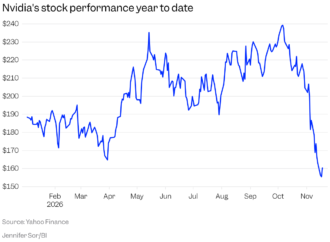
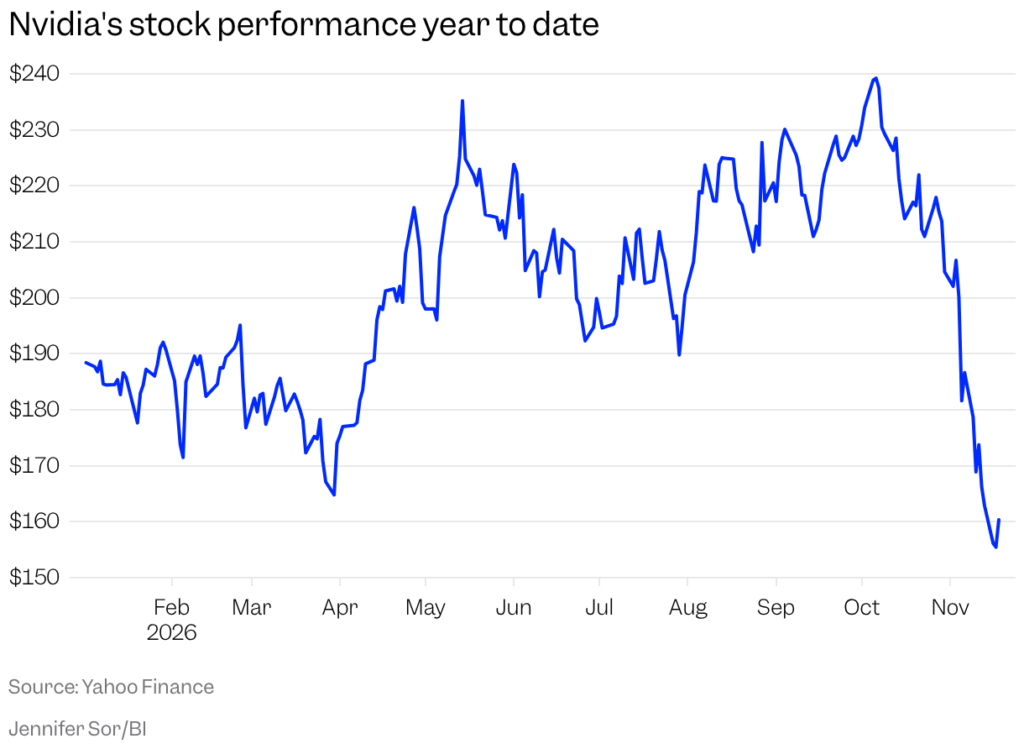
Nvidia’s shares fell 3% on Wednesday after the report and are now down over one-third from their October record, as investors weigh concerns about AI spending, China sales, and the company’s leadership.
BIT Capital, which manages more than 3 billion euros, exited its entire Nvidia position in early November.
Nvidia is cheaper after its recent slide, but the asset manager will stay out while US controls on China’s access to advanced chips remain in flux, Oldenkott said.
The Trump administration has tightened rules aimed at preventing Chinese companies from remotely accessing advanced US AI chips. Treasury Secretary Scott Bessent has publicly faulted Commerce Secretary Howard Lutnick’s department for delays in restricting a Nvidia customer suspected of helping divert chips to China.
Trump acknowledged the divide, saying he understood the competing views within his administration.

That uncertainty has overshadowed an otherwise strong quarter. Nvidia reported quarterly revenue of $115.8 billion, up 103% from a year earlier, and forecast fourth-quarter revenue above Wall Street expectations. Data-center revenue rose 110%.
Those results did not persuade BIT Capital to reverse a trade it had made weeks earlier. Nvidia had been the firm’s third-largest disclosed holding at the end of September, worth about $192 million.
The sale was not a bet on former CEO Jensen Huang’s resignation, Oldenkott said.
It sold after a surprise Texas gubernatorial result raised fears that data-center projects in the state could be delayed, sending chip and AI-infrastructure stocks lower. Nvidia held up relatively better, making other AI investments more attractive by comparison.
Comments from Lutnick, Bessent, and Trump has since made Nvidia’s risk unusually hard to assess, Oldenkott said.
Even without that political noise, he said, other AI-infrastructure names offer better value.
BIT Capital was not alone in cutting Nvidia exposure. Hedge fund Renaissance Technologies reduced its reported Nvidia holding by about 99.7% in the third quarter.
Beyond the Nvidia trade
As it sold Nvidia, BIT Capital increased its position in Silicon Motion, a Taiwan maker of NAND-flash storage controllers. US-listed Silicon Motion shares are up over 60% this year.
Samsung, SK hynix, and Micron are directing more resources toward high-bandwidth memory for AI, which could open opportunities in other parts of the storage market, Oldenkott said.
“Samsung and SK hynix are gifting their market share,” he said.
The German asset management firm also holds TSMC, which Oldenkott called a more defensive AI investment because of its dominant position in advanced-chip manufacturing.
China tech has been a harder call this year. The firm has not found enough of a valuation advantage over US cloud peers to build a high-conviction position, Oldenkott said.
Meanwhile, it is starting to look at Japan’s less-visible semiconductor supply chain, where Oldenkott sees companies “very deep in the value chain.”
It also added to Amazon and holds IREN, an AI-cloud provider, among its largest positions.
Amazon is BIT Capital’s highest-conviction investment because its cloud business can benefit whether frontier-model developers or open-source alternatives win, while its relatively conservative AI financing and established core businesses offer more protection if the market shifts, Oldenkott said.
Meanwhile, IREN has been swept up in the broader neocloud selloff, and its valuation now looks too low, Oldenkott said.
The AI selloff initially reflected genuine excess in parts of the semiconductor sector, but has now gone too far, Oldenkott said.
BIT Capital is holding more than 20% cash while selectively buying semiconductor and AI-infrastructure names.
“At the point where we are now, there are very attractive opportunities,” Oldenkott said.
Keep following us for the latest insights.