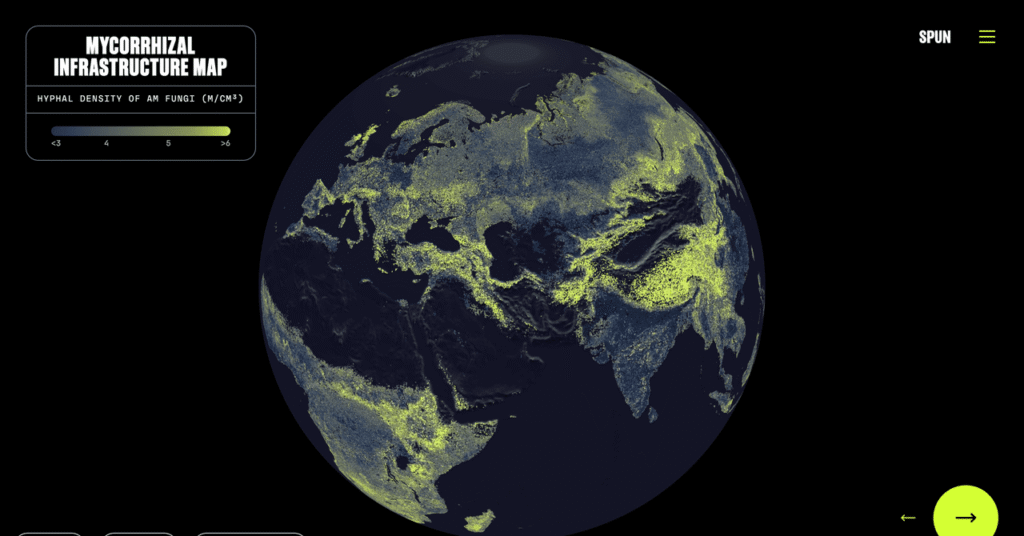
Beneath the Earth On the surface there is an extraordinary underground network of fungi of almost unimaginable scale. An international team of researchers has produced, for the first time, a global map of this vast network of mycorrhizae, the system of fungal filaments that form mutually beneficial associations with plants around the planet. They estimate
Beneath the Earth On the surface there is an extraordinary underground network of fungi of almost unimaginable scale. An international team of researchers has produced, for the first time, a global map of this vast network of mycorrhizae, the system of fungal filaments that form mutually beneficial associations with plants around the planet. They estimate that the network extends for approximately 110 trillion kilometers in total, almost a billion times the distance between the Earth and the sun. The findings were published in Science.
under your feet
Arbuscular mycorrhizal fungi (AM fungi) form underground networks that support plant life and help regulate the Earth’s climate. Through microscopic filaments known as hyphae, these fungi establish symbiotic relationships with the roots of plants, supplying water and nutrients in exchange for the carbon produced through photosynthesis. The scale of this phenomenon is enormous: current estimates suggest that around 70 percent of all plant species depend on these mycorrhizal associations for their survival.
Global network mapping
Although a study published in Nature last year examined global patterns in the diversity of subterranean mycorrhizal fungal communities, no previous research had quantified the density and global distribution of this subterranean network.
To create the first global map of this hidden system, the authors of the new study compiled data from 322 previous studies, along with 16,000 soil samples collected from a wide range of terrestrial ecosystems. Using machine learning techniques and advanced imaging technologies, the team estimated both the total extent of the network and its biomass.
“With the advent of new technologies in high-resolution imaging, machine learning and robotics, we are beginning to reveal what has long remained hidden beneath our feet,” said co-author Corentin Bisot. “We are discovering how the complex network-forming structures of fungi transport nutrients and help regulate the climate.”
An immense underground network
Researchers estimate that the underground fungal network has a total length of approximately 110 quadrillion kilometers. They also estimate that it contains about 300 megatons of carbon in biomass, which is roughly four to six times the total mass of all living humans.
According to the study, these fungal networks transport the equivalent of about 4 billion metric tons of carbon dioxide into the soil each year, accounting for about 11 percent of annual human-caused carbon dioxide emissions.
“It’s hard to overstate the importance and magnitude of these fungi,” said lead author Justin Stewart of the Society to Protect Underground Networks. “A single teaspoon of soil can contain up to 10 meters of mycorrhizal network.”
A planetary circulatory system
The researchers also issued a warning. According to the study, the density of underground fungal networks in agricultural soils is only about half that found in natural ecosystems. However, grasslands, which contain about 40 percent of the world’s arbuscular mycorrhizal biomass, are among the least protected ecosystems and are being converted to agricultural land at a rate four times faster than forests.
Scientists warn that less dense fungal networks could reduce soil’s ability to store carbon and recycle nutrients.
“Mycorrhizal fungi have shaped life on Earth for hundreds of millions of years, but we still know very little about how the infrastructure of these living transport systems is distributed across the planet,” said co-author Merlin Sheldrake. “This study marks an exciting step toward understanding how this planetary circulatory system works and points to ways we can work more effectively with fungi to address many of the defining challenges of our time, from food security to climate change.”
This story originally appeared on WIRED Italia and has been translated from Italian.
For more tech updates, stay tuned to our blog.