The enormous globular star cluster Omega Centauri has baffled astronomers for decades. It should be full of black holes left by exploding stars, but the evidence for them is scarce. Now, astronomers using archival data from NASA’s Hubble Space Telescope and supporting observations from NASA’s James Webb Space Telescope have finally located their first stellar-mass
The enormous globular star cluster Omega Centauri has baffled astronomers for decades. It should be full of black holes left by exploding stars, but the evidence for them is scarce. Now, astronomers using archival data from NASA’s Hubble Space Telescope and supporting observations from NASA’s James Webb Space Telescope have finally located their first stellar-mass black hole in this cluster. Discovering the first of this missing black hole population will help refine current theories about black hole formation in environments like Omega Centauri. The team’s findings were published Monday in The Astrophysical Journal Letters.
Omega Centauri is made up of 10 million stars gravitationally bound together. Although the astronomical community previously found evidence with Hubble that an intermediate-mass black hole lurks at its center, models suggest that this star cluster should also contain around 10,000 smaller stellar-mass black holes. This notable population of black holes evaded detection in previous observational studies, which used the radial velocity method or looked for radio and X-ray emissions from material falling onto the black holes.
This new discovery presents a different approach, known as astrometry, to measuring very small movements of stars over time. By sifting through more than 20 years of archival Hubble data and mining recent Webb data to further refine their astrometric measurements, the team located a star orbiting an invisible object so heavy it has to be a black hole. Dubbed oMEGACat BH-2, it is the first stellar-mass black hole detected in Omega Centauri and has some surprising qualities. oMEGACat BH-2 is lower mass than expected and, with its visible companion star, the black hole-star duo has the longest orbital period of any black hole binary system known to date.
“Using the Hubble and Webb data, we were able to see the motion of the visible main sequence star that is part of this binary, which is located about 18,000 light years away in the dense environment of Omega Centauri,” said Matthew Whitaker of the University of Utah, Salt Lake City, lead author of the paper. “The precision of these measurements is incredible, down to a fraction of a pixel in the Hubble and Webb detectors. It would not have been possible to find this black hole without these two space telescopes.”
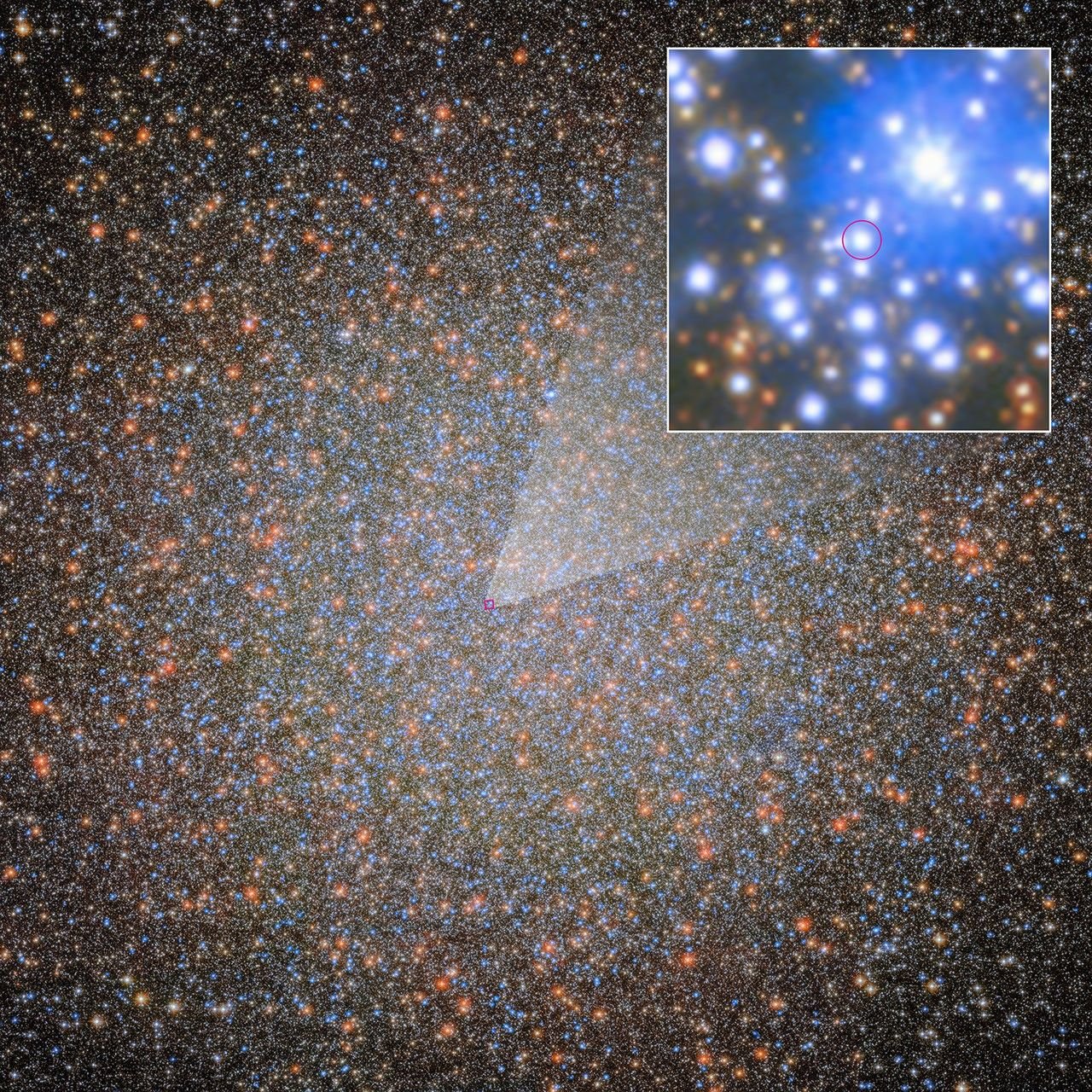
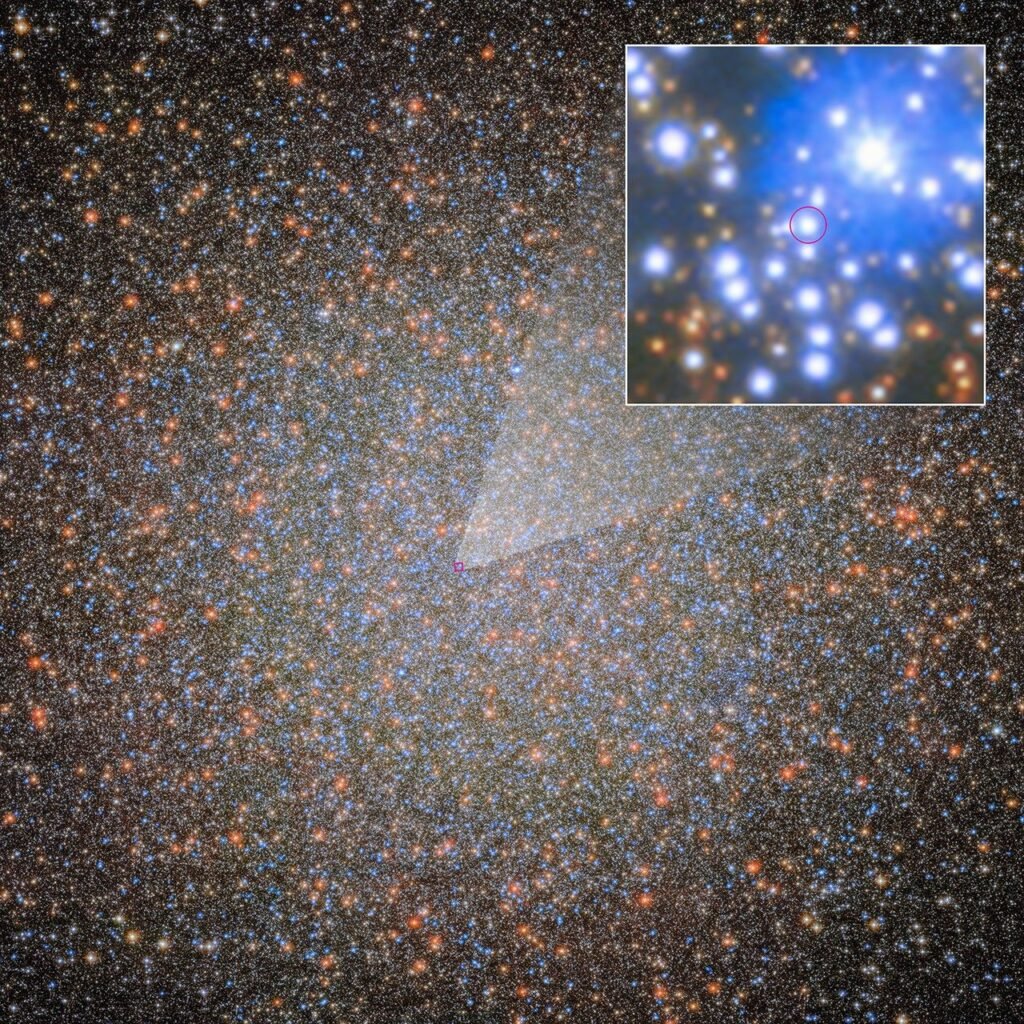
Astronomers found Omega Centauri’s first stellar-mass black hole, which has a visible companion star shown in greater detail. They used more than 20 years of data from NASA’s Hubble Space Telescope and recent data from NASA’s James Webb Space Telescope to make the discovery.
Image: ESA, NASA, Maximilian Häberle (MPIA), Joseph DePasquale (STScI)
The team’s findings refine an earlier study by a different group of scientists that suggested this binary system included a neutron star. By augmenting Hubble data from previous research with archival Hubble astrometric measurements from 2002 to 2023, and incorporating near-infrared data from Webb to improve accuracy, the University of Utah-led team was able to better constrain the mass of the visible star’s dark companion, ruling out the possibility of a neutron star.
“Although we already knew that the star was 0.78 solar masses, we can now calculate the mass of the black hole, which is 4.46 solar masses and therefore too heavy to be a neutron star. However, its mass is much lower than would be expected in a metal-poor environment like Omega Centauri. This is surprising and exciting,” said Anil Seth of the University of Utah, co-author of the study. “We now know that a metal-poor star is capable of forming a black hole like this, and we need to figure out how that happens. This detection is providing some data to those doing that kind of modeling.”
Relying on precise data from Hubble and Webb, the team was able to trace the star’s trajectory for more than 20 years, during its closest approach to its companion black hole, when it was moving fastest across the sky. From the vast amount of data, the team determined that the visible star oMEGACat BH-2 orbits once every 94 years, making it the longest-period binary black hole ever known.
Its long orbital period also gives a clue to the origin of this binary system. It probably formed dynamically, meaning that the star and its companion, the black hole, did not start out together, but rather found themselves in this cluster. The researchers calculated that a system like oMEGACat BH-2 will survive less than a billion years before being torn apart by encounters with nearby stars, a period much shorter than the age of the cluster (about 12 billion years).
“It is important to understand black hole populations in globular clusters because there is uncertainty about their physics and formation,” Seth said. “More specifically, understanding the process of black hole formation and then dynamical formation of binaries is vital, because it affects our ability to interpret and understand gravitational wave events. Environments like Omega Centauri are the main places where we believe binaries merge and create these waves.”
The team’s discovery of the oMEGACat BH-2 stellar-mass black hole with the Hubble-Webb data set is just the beginning of the search for these elusive populations of black holes in globular star clusters.
“With Hubble and Webb, we can continue analyzing Omega Centauri and expand our search for similar systems within other groups,” Whitaker said. “We are also very excited about the launch of NASA’s Nancy Grace Roman Space Telescope because it will image the crowded galactic bulge, including the galactic center, very regularly at a resolution similar to that of Hubble and with a much wider field of view. We hope to be able to find black hole binary systems like this due to the regular cadence of Roman’s observations.”
The Hubble Space Telescope has been operating for more than three decades and continues to make groundbreaking discoveries that shape our fundamental understanding of the universe. Hubble is an international cooperation project between NASA and ESA (European Space Agency). NASA’s Goddard Space Flight Center in Greenbelt, Maryland, manages the telescope and mission operations. Denver-based Lockheed Martin Space also supports mission operations at Goddard. The Space Telescope Science Institute in Baltimore, operated by the Association of Universities for Research in Astronomy, conducts Hubble science operations for NASA.
Keep following us for the latest insights.