The global tech selloff is spilling beyond stock markets, prompting some of the AI boom’s biggest beneficiaries to rethink plans to raise money through public listings. On Friday, South Korean memory-chip giant SK Hynix said it was abandoning a review of a potential US initial public offering of its Solidigm subsidiary, citing market volatility and
The global tech selloff is spilling beyond stock markets, prompting some of the AI boom’s biggest beneficiaries to rethink plans to raise money through public listings.
On Friday, South Korean memory-chip giant SK Hynix said it was abandoning a review of a potential US initial public offering of its Solidigm subsidiary, citing market volatility and a broader correction in semiconductor stocks.
“In light of recent capital market conditions and share price trends, Solidigm determined that it was necessary to reassess whether an IPO would be the most beneficial option for SK hynix and its existing shareholders at this time,” the company said in a statement.
SK Hynix shares fell as much as 4% in South Korea on Friday before reversing losses to close 4% higher. Rival Samsung Electronics closed 0.5% higher after early losses.
The benchmark Kospi index closed 0.3% higher. Meanwhile, Japan’s Nikkei 225 ended 0.3% lower.
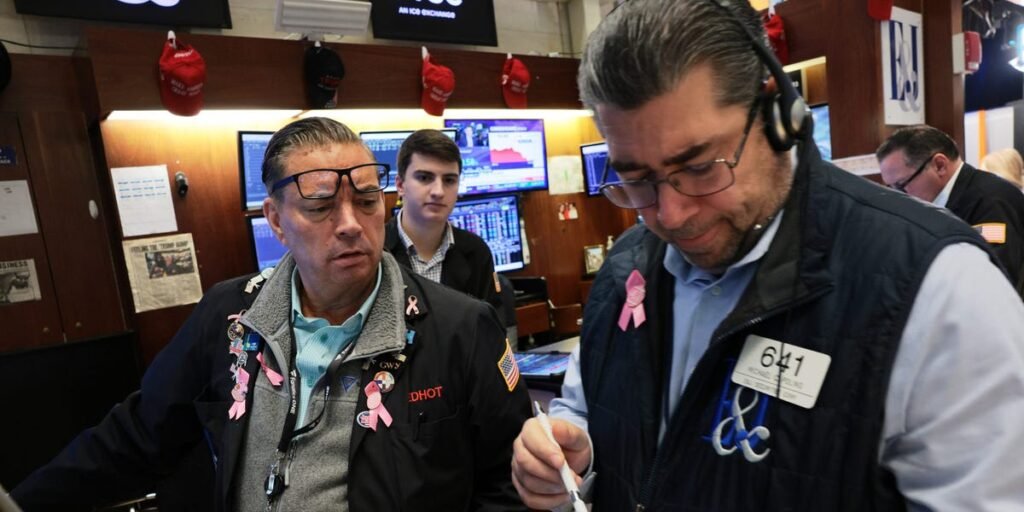
The moves followed Thursday’s Wall Street rout, when the Nasdaq Composite fell 3% amid growing questions about the returns on massive AI investments. The Philadelphia Semiconductor Index plunged 7%
The selling had spread beyond the more speculative corners of the AI trade, wrote Chris Weston, head of research at Pepperstone.
“This is no longer simply a market punishing highly leveraged AI companies with questionable funding economics,” Weston wrote in a note on Friday.
Investors were cutting exposure across the AI sector, including companies with stronger balance sheets and established earnings, he added.
That selling has caught up with even some of the AI boom’s biggest winners.
SK Hynix has been one of the AI boom’s biggest winners, thanks to its leadership in high-bandwidth memory, a crucial component of Nvidia’s AI processors.
The company joined the trillion-dollar club earlier this year before a sharp selloff knocked it out. In July, it raised $26.5 billion through a Nasdaq listing of American depositary receipts, one of the largest share offerings in history.
Its subsidiary Solidigm, which specializes in NAND flash memory and solid-state drives, had been considering a listing as one way to finance a proposed US chipmaking facility amid growing demand for AI data center storage.
The proposal had also faced opposition from South Korean regulators over shareholder-protection concerns.
“This decision does not reflect any change in Solidigm’s growth prospects or investment needs,” SK Hynix said, adding that it would continue evaluating other financing options.
The IPO market is losing momentum
The turbulence has also hit companies that have already gone public. South Korean AI cloud operator Elice plunged 32% in its Kosdaq debut on Tuesday, despite its IPO drawing demand roughly 400 times the shares available. Its stock rebounded 30% the following day, underscoring the volatility gripping newly listed tech companies.
Others have decided against testing the public markets altogether.
Earlier this month, Nvidia-backed Australian data center operator Firmus withdrew its planned $5 billion IPO after the offering met weak investor demand.
The company cited market conditions and said the terms did not adequately reflect its growth prospects. It said it would pursue private fundraising instead.
The pullback has extended beyond AI infrastructure. Smart-ring maker Oura postponed its US IPO in September despite what it described as strong investor demand, citing market uncertainty.
The decisions come against a backdrop of cooling IPO activity.
The dollar volume of global IPO filings fell 33% in September from a year earlier, according to RBC Capital Markets in a report earlier this month.
Weston said elevated trading volumes across the AI ecosystem suggested the latest selling pressure could persist.
“There’s nothing more emotive than a falling market where buyers refuse to engage. Sellers don’t need a fresh catalyst when deteriorating price action itself encourages more selling,” he wrote.
Keep following us for the latest insights.