Every spring in Palestine, Texas, the wide-open fields around NASA’s Columbia Scientific Balloon Facility fill with students and faculty from across Louisiana. They arrive carrying sensors, laptops, and carefully engineered payloads they have spent months preparing. The goal is to send their experiments to the edge of space and return with meaningful data, while reflecting
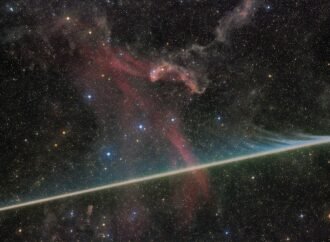
Explanation: What’s happening to this meteor? This bright meteor streak appeared and disappeared quickly during a long exposure of the Great Lacerta Nebula, seen faintly in red toward the center of the image. The meteoroid, likely a small pebble, creates its glow partly by heating and exciting surrounding air in Earth’s atmosphere, but itself vaporizes and leaves wind-blown gas and dust with colors that
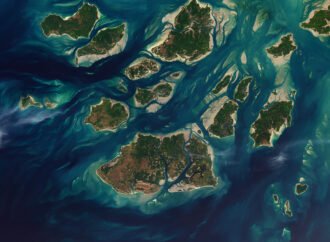
Twice each day, tides ebb and flow through a maze of sandy channels, mudflats, and mangrove forests that flank the 88 islands and islets of Guinea-Bissau’s Bijagós Archipelago (Arquipélago dos Bijagós in Portuguese). Seen from above in this image from Nov. 28, 2025, the process leads to stark changes to the landscape: around low tide, intertidal mudflats and sandflats
From June 11 through July 19, NASA’s free interactive exhibit at FIFA Fan Festival™ brought space exploration to soccer fans in East Downtown Houston. More than 500,000 visitors explored the exhibit during the tournament, learning how the agency’s missions, research, and technology benefit life on Earth. The exhibit introduced a global audience to the Artemis program, Moon Base, the International Space Station,
From serving in the U.S. Army to helping prepare astronauts to explore the lunar surface, Ike Theriot built a path to NASA through discipline and determination. Theriot serves as the Flight Operations Surface Testing lead in the Exploration Extravehicular Activity Operations Branch within the EVA, Robotics, and Crew Operations Division at NASA’s Johnson Space Center in Houston. He integrates flight operations testing needs
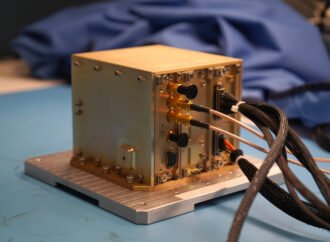
NASA delivered the NavCube3-mini payload on July 13 to Intuitive Machines for integration into Altus-1, the company’s first lunar relay satellite, marking an important milestone in the development of future lunar communications and navigation services. The lunar relays are designed to enable communications and navigation for astronauts and rovers operating at the agency’s future Moon Base. About half the size of a shoebox and weighing just 3.5 pounds, NavCube3-mini is a compact but powerful navigation