Public money does more than support frontier technologies, it helps to shape the markets that grow around them. Through decisions on contracts, grants, benchmarks, infrastructure and purchasing routes, governments influence which firms learn first, which systems are adopted and whether markets stay open or closed. Governments must recognize their role in shaping future competition in
Public money does more than support frontier technologies, it helps to shape the markets that grow around them. Through decisions on contracts, grants, benchmarks, infrastructure and purchasing routes, governments influence which firms learn first, which systems are adopted and whether markets stay open or closed.
Governments must recognize their role in shaping future competition in frontier-technology sectors. When possible, they should make choices that widen the markets they help to create and not turn them into gateways controlled by a few private firms.
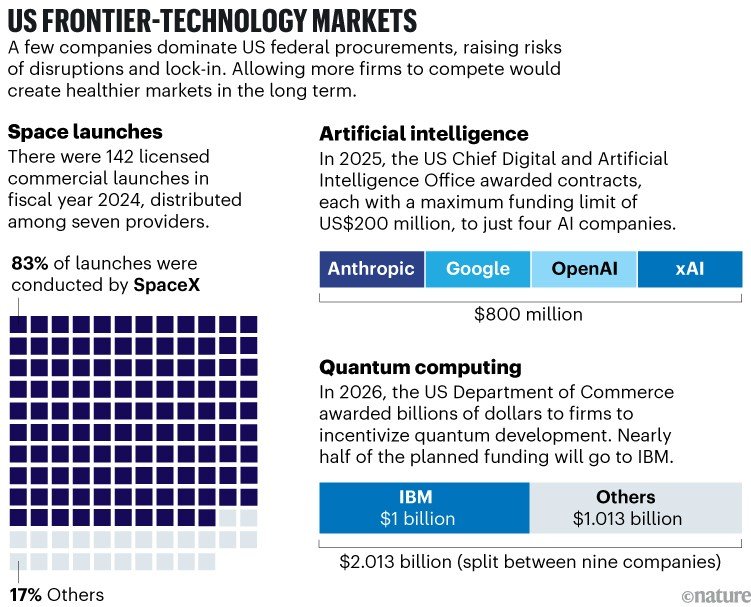
Concentration is already evident in parts of the space sector1. In artificial intelligence and quantum technologies, the choices governments are making now — on which capabilities to fund and procure, how to assess and deploy them and how to govern their use — will influence future use and investments (see ‘US frontier-technology markets’).
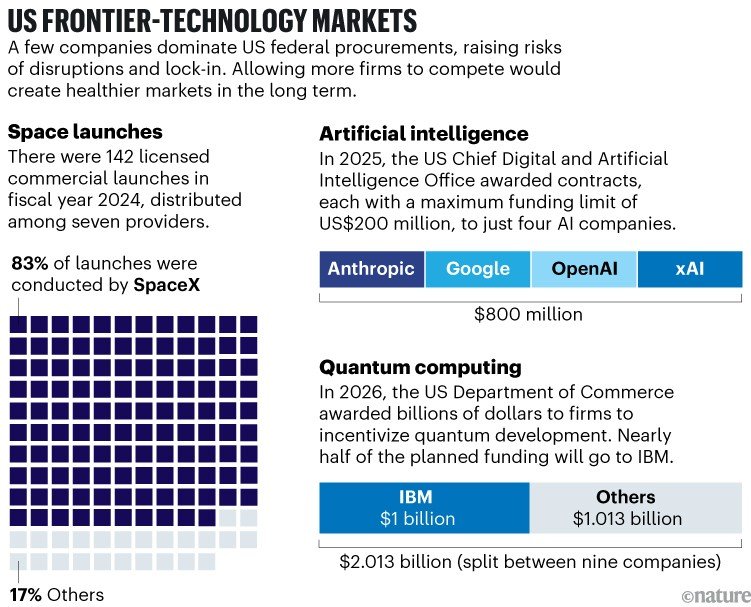
Source, top to bottom: Ref. 1; go.nature.com/5r6y8j; go.nature.com/4xah8
Leading suppliers of frontier technologies might owe their position to outstanding performance. But repeated awards to the same supplier can become a problem if they make one system the default around which future work is planned.
Here, we call on governments to adopt safeguards that take account of how their procurement, adoption and evaluation decisions for cutting-edge technology will shape future markets and affect the scope for later competition. The central principle is contestability: public support should reward performance today, without denying later suppliers the access that they need to offer better solutions and compete on their merits.
How technological lock-in happens
The space sector illustrates how market constraints emerge. Governments are major customers for space services, and their procurement decisions determine which firms learn and build capability — and attract future investments. The mission launch itself generates evidence about what works, which gives the supplier an edge that makes its system easier to choose again.
For example, SpaceX, headquartered near Brownsville, Texas, conducted 118 launches — 83% of the total — licensed by the US Federal Aviation Administration (FAA) in fiscal year 20241. In April 2025, the same company was assigned seven of the nine national-security launch missions from that year’s budget, at a total price of US$846 million; the remaining two missions went to another established provider at $428 million.

In 2025, NASA and the firms Axiom Space and SpaceX launched a private astronaut mission to the International Space Station.Credit: Cristobal Herrera-Ulashkevich/EPA/Shutterstock
In launch provision, a supplier’s advantage might come from its record of reliability, built through a series of successful missions. In cloud computing and AI, it might stem from the habits formed when agencies learn one way to buy, secure and use systems. In quantum technologies, it might come from the authority attached to publicly funded testing facilities, which can make some approaches seem more credible than others.
The concern is whether today’s choices make tomorrow’s alternatives prohibitively costly or impractical. For public buyers, switching tools might require moving data or rebuilding interfaces. For firms, entry into a market might depend on access to technical data or infrastructure held by established players.
In the space sector, NASA estimated that bringing in a new supplier for key parts of its Space Launch System could cost more than US$4.5 billion and delay the launch by ten years, because existing contractors held crucial technical data2. In cloud services, the UK Competition and Markets Authority found in 2025 that fewer than 1% of customers switch providers each year, mainly because the expected benefits of the new service do not outweigh the costs of switching3.

The science of foresight: how to future-proof your research
The consequences are extensive. Satellites are widely used for positioning, navigation and timing services, communications, environmental monitoring and defence4. When several public missions rely on just a few suppliers, a cyberattack, production stoppage or other disruption at one firm can affect many missions at once.
Limited alternative providers also weaken governments’ bargaining positions and reduce competitive pressure on price, quality and innovation. The risks are greater when one firm controls launch capacity as well as satellites, data and downstream services, giving it influence over access, prices, interoperability and standards.
Safeguards are therefore needed before early advantages harden into bottlenecks. Government agencies should ask what a later supplier would need to gain access, connect to the system, undergo assessment or replace the established supplier. Future contestability depends on whether those channels are practical.
Examples of wider procurement approaches
Some public programmes already take steps to avoid closing off alternative providers: contracting multiple firms, performing staged assessments so new entrants can join later, creating open interfaces that aren’t tied to one vendor and maintaining supplier entry routes. But safeguards remain uneven.
NASA’s Commercial Lunar Payload Services programme is one positive example. Rather than controlling all missions itself, NASA buys delivery services from a range of commercial providers. This enables NASA to share payload risk and learning across suppliers of lunar delivery services. It can absorb early failures without turning one result into a final verdict.
For example, Peregrine Mission One, developed by Astrobotic Technology in Pittsburgh, Pennsylvania, launched in January 2024 but did not reach the lunar surface. A month later, IM-1, from Intuitive Machines in Houston, Texas, made the first commercial soft landing on the Moon but tipped over. Firefly Aerospace, based in Cedar Park, Texas, then launched Blue Ghost, which successfully landed upright in March 2025 with ten NASA payloads. Days later, Intuitive Machines’s IM-2 landed on its side, ending the mission early, although it did return data.
Those lessons will feed into future mission designs. Yet, refining missions often entails extra costs and schedule adjustments. For instance, a 2024 NASA audit found that five of eight task orders it examined had experienced delays, increasing their costs by $208 million5.
A market-building programme needs discipline, termination points and cost control to avoid committing funding to suppliers indefinitely. But it also needs enough flexibility to absorb fresh information as it comes in.

Space diplomacy: bridging the operating gaps between myriad missions
One solution is staged commitment: agencies buy what they need now and hold suppliers to reliability and cost requirements, while keeping a clear way for later suppliers to qualify, compete and win. This approach should become routine.
The Commercial Orbital Transportation Services, for example, was a 2006–13 NASA programme designed to spur private development of spacecraft for deliveries to the International Space Station. It paid suppliers once they reached technical goals and split awards between several partners while the commercial cargo market was still being formed. The US Space Force contracting mechanism similarly leaves room for newer launch providers to qualify when they are ready. In 2025, NASA awarded space-technology company Blue Origin, based in Kent, Washington, with a task order called the Volatiles Investigating Polar Exploration Rover. Funding for preparatory work is separated from the agency’s later decision of whether to buy lunar delivery.
The European Space Agency’s European Launcher Challenge uses a staged process to increase choice and competition. The European Union’s secure-connectivity satellite constellation programme, IRIS² (Infrastructure for Resilience, Interconnectivity and Security by Satellite), promotes the participation of new entrants and requires that a share of large contracts be subcontracted to firms other than the main provider.
India permits private firms to operate across the space value chain, including building and operating satellites and developing and launching rockets. The government manages this through two institutions: IN-SPACe authorizes and supervises private activity, and the Indian Space Research Organisation remains focused on research and development, training and expertise. A government-approved venture-capital fund worth around $120 million eases financing constraints. Yet it remains to be seen whether promising ventures will become robust competitors.
Requirements for quantum and AI
Quantum-technology markets are still taking shape, with governments having to assess competing technical claims as well as choose among finished services. The United Kingdom’s National Quantum Strategy, for example, has committed £2.5 billion (US$3.4 billion) in public funding for quantum research and development over ten years from 20246.
Here, too, government-certified benchmarks, testing facilities and standards can confer credibility before commercial users know which approaches will work. The risk is that the power to assess credibility could become concentrated. If only a small number of actors control access to standards, tests and facilities, others might struggle to generate the evidence needed for their technologies to be taken seriously.
The safeguard is a clearly specified, staged assessment that remains open to entrants and gives competing approaches opportunities to be proven. In the United States, the Defense Advanced Research Projects Agency’s (DARPA’s) Quantum Benchmarking Initiative shows how this can work, in three stages.

Quantum computers promise to transform many sectors in the next decade.Credit: Angel Garcia/Bloomberg via Getty
Rather than selecting an architecture on the strength of early promises, DARPA asks during Stage A whether a proposal offers a path to a quantum computer with a computational value that would exceed its cost. In Stage B, the research and development plan is scrutinized, including risks, measures for mitigating them and prototypes needed to test the approach. In Stage C, DARPA works with each firm to validate its claim that the proposed computer can be constructed as designed and operated as intended. DARPA assesses each approach on its merits and does not predetermine how many will succeed. Weak claims are rejected without prematurely closing the market.
There is a trade-off, however. Assessment must be rigorous enough to test claims, protect intellectual property and preserve assessment integrity, but not so narrow that one technical design is locked in before the evidence shows which approach is best.
Check back often for more exciting news!