This composite image, released on July 9, 2026, shows the region around a pulsar (a neutron star with a strong magnetic field that spins incredibly fast) within the Lighthouse Nebula. The image contains X-ray data from NASA’s Chandra X-ray Observatory in purple, X-rays from NASA’s IXPE (Imaging X-ray Polarimetry Explorer) in blue, and radio emissions
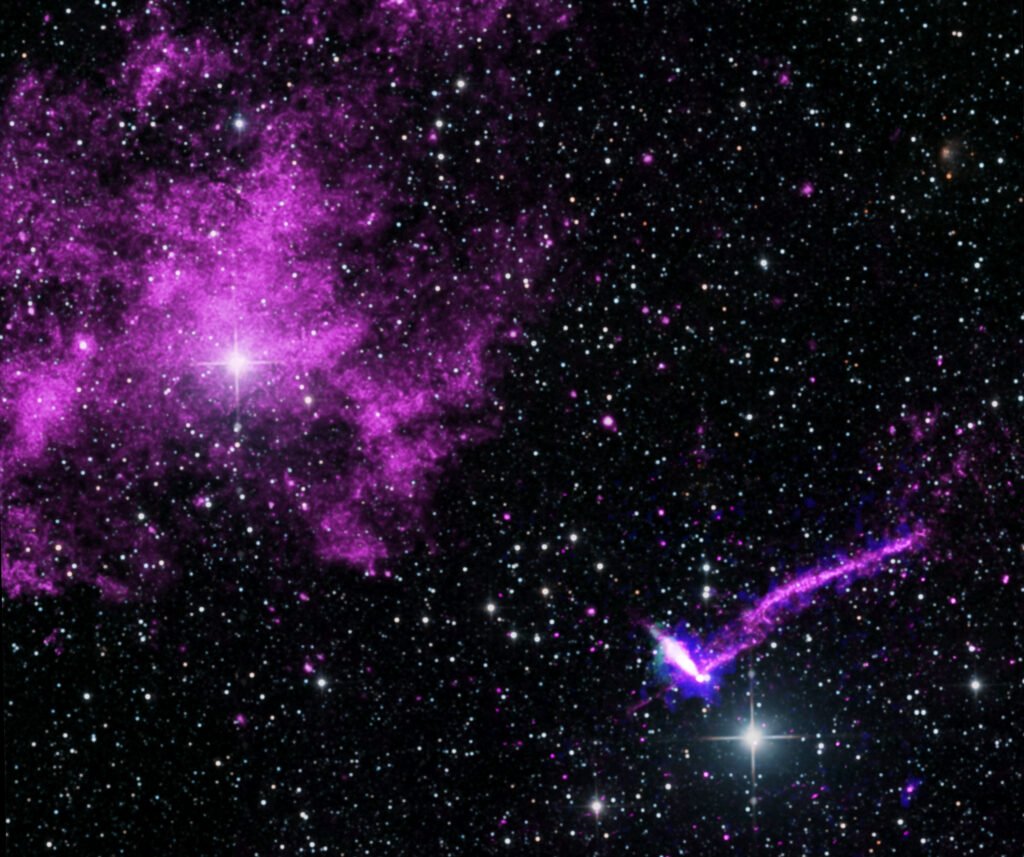
This composite image, released on July 9, 2026, shows the region around a pulsar (a neutron star with a strong magnetic field that spins incredibly fast) within the Lighthouse Nebula. The image contains X-ray data from NASA’s Chandra X-ray Observatory in purple, X-rays from NASA’s IXPE (Imaging X-ray Polarimetry Explorer) in blue, and radio emissions captured by the Australia Compact Telescope Array in green.
Scientists used IXPE, for the first time, to directly measure the pulsar’s magnetic fields. The results provide new insight into the structure of some of the most extreme objects in the cosmos, as NASA continues to explore the secrets of how the universe works. A paper describing the results was published July 9 in the Astrophysical Journal.
Read more about this novel use of IXPE.
Image credit: X-ray: Chandra: NASA/CXC/Stanford Univ./J. Dinsmore et al. IXPE: NASA/MSFC/J. Dinsmore et al., Radio: CSIRO/ATNF/ATCA; Optical: 2MASS/UMass/IPAC-Caltech/NASA/NSF; Image processing: NASA/CXC/SAO/L. Frattare
For more tech updates, stay tuned to our blog.