“When you begin again, you repeat everything,” reflects experimental filmmaker Ana Vaz, thinking of her home country Brazil and the setting of her new feature, “Hanabi,” in Japan. “There’s a normalization of the state of catastrophe and disaster necessary for the system to perpetrate itself. It needs catastrophe in order to exist.” In the wake
“When you begin again, you repeat everything,” reflects experimental filmmaker Ana Vaz, thinking of her home country Brazil and the setting of her new feature, “Hanabi,” in Japan. “There’s a normalization of the state of catastrophe and disaster necessary for the system to perpetrate itself. It needs catastrophe in order to exist.”
In the wake of the Fukushima nuclear disaster, Vaz felt a resonance with the preoccupations with land, people and colonialism that have defined her filmography to this point. “Hanabi,” or “Fire Flower,” weaves in imagery normally associated with healing — farmers, gardens and fireworks — to communicate a profound unease with the silence of present-day Japan.

‘Hanabi’
Courtesy of tambores, a noite and Les Volcans
Vaz had been filming Japan for two years when she first encountered the work of Yoko Hayasuke in a French essay anthology entitled “Fukushima et ces Invisibles.” The Brazilian experimental filmmaker was interested in the 2011 Fukushima nuclear accident caused by the Tōhoku earthquake and tsunami through Hayasuke’s micropolitical lens, which transformed quotidian observations on capitalism into “metaphysical troublings.”
“What do you consume? Where do you go?” asks Vaz, rephrasing Hayasuke, questioning the proliferation of post-modern uncertainties. “Taking the plane, eating out, drinking a coffee. All of these minor, everyday events gain a completely different dimension when reconsidered.”
“Hanabi,” Vaz’s heretofore longest film, loosely adapts Hayasuke’s “Journal of a Radioactive Brain,” in which the author conveys her struggle to live in a Japan desperate to deny its permanent irradiation following the accident. The film inherits the text’s scrambled structure, with Hayasuke’s diary entries addressed in the second person to herself in a non-linear assemblage.
“The anxious affect throughout the film allows us to be connected to something beyond a reasoned understanding,” she adds. “Particularly in the case of Fukushima, it seemed important to think beyond science: beyond official numbers or regular forms of measurement that are quickly surpassed through the enormity of the event.”
Imagining a future after a disaster is one of the text’s central preoccupations, equally intriguing Vaz. The only intervention from the director to the script’s content is a slip of the tongue while reading aloud Hayasuke’s “I would rather be a zombie than a mother.”
In the same breath, Vaz unconsciously responded with, “I would rather be a mother than a zombie.” She had just discovered she was pregnant while recording the narration. Chaghig Arzoumanian, the film’s editor, insisted that they keep it in.
This is also the first film for which Vaz has ceded editing responsibilities. As a film so devoted to marginal subjectivities, “Hanabi” teeters on the brink of incoherency, a dance woven into both the text and Vaz’s adaptation. The director credits Arzoumanian with much of the final film’s success.
“It was 10 years in the making, and two in which we were editing the film,” Vaz said. “My brilliant editor, Chaghig, brought a great deal of sensibility and structure to this tapestry as we worked little by little.”
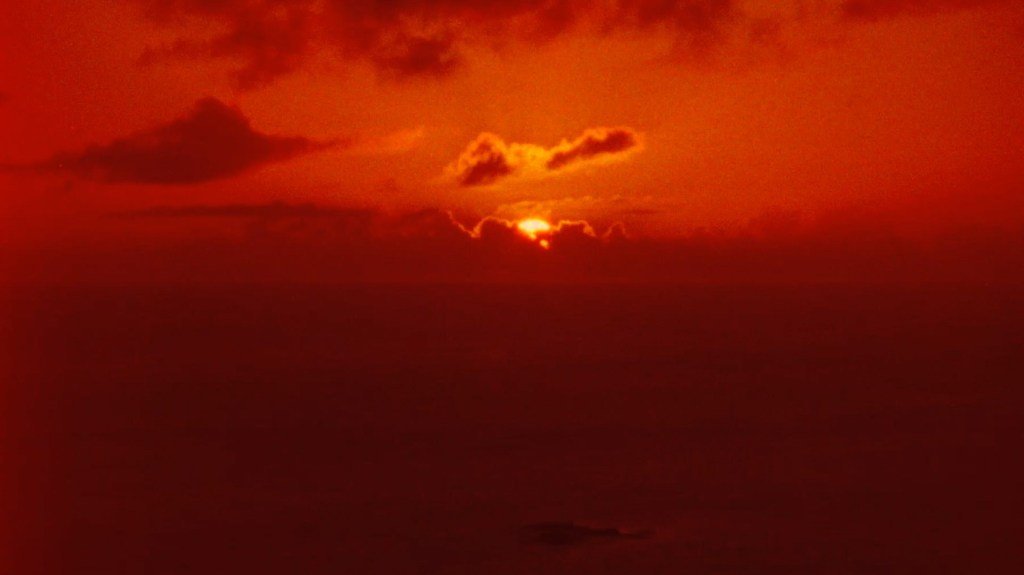
The voiceover accompanies short interviews with survivors of the fallout and extended reveries, where Vaz waves her 16mm camera wildly through contaminated grasslands, or holds it still to observe the descent of a candescent sun into the sea — the latter observed by Vaz’s previous collaborator, philosopher Juliana Fausto, as “a wonderful scene to ponder” midway through the film, with the sun also being the byproduct of radioactive fusions.
As Hayasuke’s text struggles against a regime of silence in Japanese society, Vaz’s adaptation works against the invisibility of radiation, attempting a number of tactics to materialize the invisible. Their greatest challenge was balancing the multiple registers of the film’s oral testimonies with Hayasuke’s plea to not speak alone in the book’s literary prose.
“I’m often really trying very hard for the camera not to be this instrument of appropriation and extraction that it has been in the history of cinema,” elaborates Vaz. “In that sense, it’s interesting that ‘Hanabi’ has accompanied me for the last 10 years. There are many other films that were done in parallel, but they’re all related to one another. I think they’re all part of the same disquiet.”
A persistent tick accompanying the film’s improvised jazz soundtrack composed by Nuno da Luz evokes atomic histories and Geiger counters, atop eerily empty visions of the urban landscape in Japan. “Hanabi” thus sounds the alarm, positing an approach to coping with the unimaginable.
“In the face of continuing disasters, this need for an international network of solidarity and of thinking is extremely valuable,” concludes Vaz. “‘Hanabi’ hasn’t ended. There is a version of it now that we can see in the cinema. But everything surrounding it continues to live.”
Check back often for more exciting news!