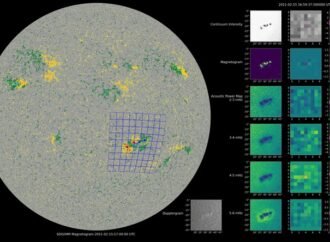
As humanity looks to the Moon and stars for future exploration, predicting space weather — conditions in space primarily driven by the Sun — is more important than ever. Now, a team of astrophysicists and data scientists with NASA’s COFFIES (Consequence Of Fields and Flows in the Interior and Exterior of the Sun) has developed a
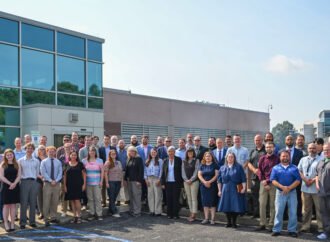
Growing up in Grafton, West Virginia, engrossed in Star Wars and all things science fiction, Fletcher Newell had an early interest in space exploration. That interest only grew when, in 2013, his fourth-grade class took a field trip to a nearby NASA facility he had not yet heard of – NASA’s Katherine Johnson Independent Verification
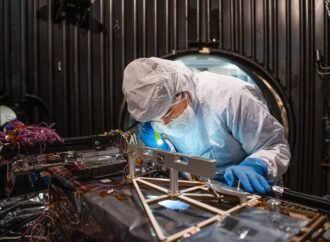
NASA has declared “wrenches down” on the first completed payload designed for Artemis astronauts to deploy on the Moon’s surface. Engineers working on NASA’s Lunar Environment Monitoring Station, or LEMS, have completed hardware development and testing and the payload is ready for its permanent home near the lunar South Pole. With the hardware complete, LEMS
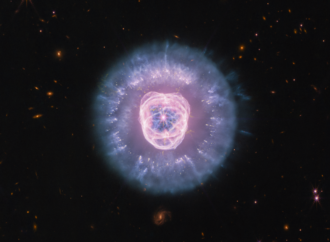
Observing across the starry “plains” of space, NASA’s James Webb Space Telescope has taken new images of NGC 2392, nicknamed the Lion Nebula. NASA’s Hubble Space Telescope previously viewed this planetary nebula in 2000, imaging the lion face-shaped target in visible light and revealing features such as the “mane” of hazy, comet-shaped objects. Now Webb
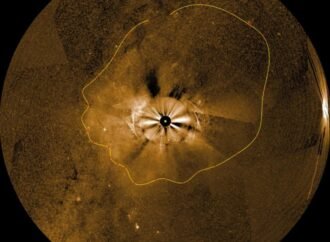
Using continuous imagery from NASA’s PUNCH (Polarimeter to Unify the Corona and Heliosphere) mission, scientists predicted the near-Earth arrival of a solar eruption to within 30 minutes in an initial proof of concept test. The results, presented Tuesday at the Committee on Space Research Scientific Meeting and under review at the journal Space Weather, could
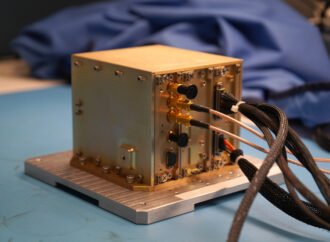
NASA delivered the NavCube3-mini payload on July 13 to Intuitive Machines for integration into Altus-1, the company’s first lunar relay satellite, marking an important milestone in the development of future lunar communications and navigation services. The lunar relays are designed to enable communications and navigation for astronauts and rovers operating at the agency’s future Moon Base. About half the size of a shoebox and weighing just 3.5 pounds, NavCube3-mini is a compact but powerful navigation