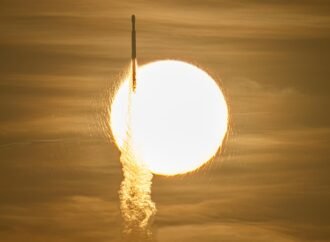
Now on a three-month, million-mile journey to its final orbit, NASA’s Nancy Grace Roman Space Telescope will soon reveal the universe’s darkest secrets. The mission launched at 7:26 a.m. EDT Sunday aboard a SpaceX Falcon Heavy rocket from Launch Complex 39A at the agency’s Kennedy Space Center in Florida. Roman pairs a large field of
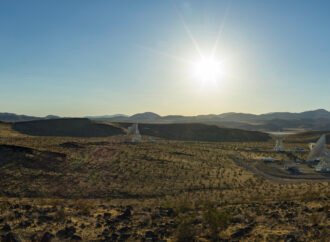
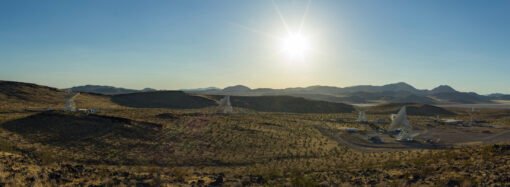
NASA’s Deep Space Network facility in California is marking the addition of a brand new 34-meter-wide (114-foot-wide) radio frequency antenna to the agency’s deep space communications and navigation system. The network uses giant dish antennas located at three global facilities to support more than 40 spacecraft exploring the solar system and interstellar space. The new
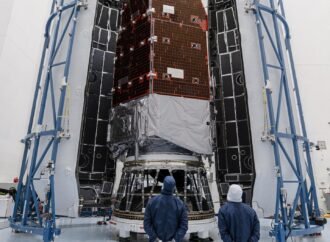
Coverage plans are ready for NASA’s Nancy Grace Roman Space Telescope prelaunch and launch activities. Roman is NASA’s next-generation observatory designed to explore some of the universe’s biggest mysteries, including dark energy. NASA and SpaceX are targeting Roman’s liftoff for no earlier than 7:26 a.m. EDT Sunday, Aug. 30, aboard a SpaceX Falcon Heavy rocket
A NASA-funded air pollution monitoring network has provided one of the most detailed long-term views yet of the role of black carbon, or soot produced by fires, diesel vehicles, and other combustion sources, in Ethiopia’s capital, Addis Ababa. The detailed measurements show how pollution changes by time of day and season, including increases associated with
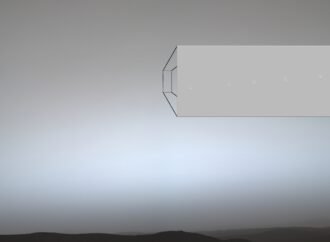
Earth and the Martian moon Phobos dance together in a series of images recently acquired by NASA’s Perseverance Mars rover. Earth appears as a point of light in the Martian sky, disappearing behind the crescent of Phobos, the larger of Mars’ two moons. This is the first time humanity has captured from the surface of
NASA is making progress in building the Moon Base, which will become a resilient outpost near the Moon’s South Pole for science, technology, and eventual human operations. To advance lunar surface infrastructure development, commercial partners such as Blue Origin, Firefly Aerospace, Intuitive Machines, and Voyager Lunar Systems are working toward delivering landers by 2028. These