
Kelsey Pfendler is trying to become the youngest woman to row solo from California to Hawaii
- Conservation, Environment, Ocean, SCIENCE
- May 28, 2026

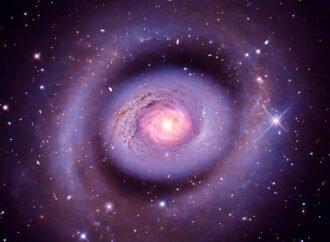
NASA’s Chandra In this image, X-rays of different wavelengths from Chandra (red, orange and blue) are overlaid with a visible light image from astrophotographers using their ground-based telescopes (red, green and blue). Experience this image through sound. Image credit: X-ray: NASA/CXC/SAO; Optical: Brian Brennan and Remi Lacasse; Image processing: NASA/CXC/SAO/L. Frattare and K. Arcand Check
READ MORE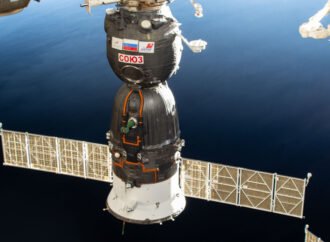
NASA astronaut Chris Williams and Roscosmos cosmonauts Sergey Kud-Sverchkov and Sergei Mikaev are concluding their 241-day mission aboard the International Space Station. The crew and their Soyuz MS-28 spacecraft will undock from the orbital laboratory’s Rassvet module at 3:02 a.m. EDT on Sunday, July 26, and head for a parachute-assisted landing at 6:26 a.m. (3:26
READ MORE
The media is invited to NASA Langley Research Center in Hampton, Virginia, on Friday, July 31, to attend a press tour and ribbon-cutting ceremony for the Flight Dynamics Research Center, the agency’s first new wind tunnel in more than 40 years. The event will include a brief media availability with: NASA Administrator Jared Isaacman Dr.
READ MORE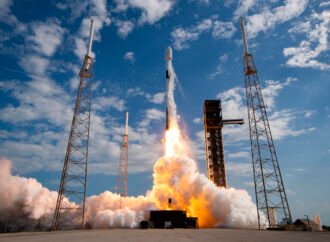
Following liftoff from Cape Canaveral on July 21 aboard a SpaceX Falcon 9 rocket, the Robotic Mission Vehicle (MRV) hosting the NASA-backed Robotic Geosynchronous Satellite Servicing (RSGS) payload is now en route to geosynchronous Earth orbit, where it will use its advanced robotics to service spacecraft. RSGS leverages NASA’s space robotics expertise, aligned with the
READ MORE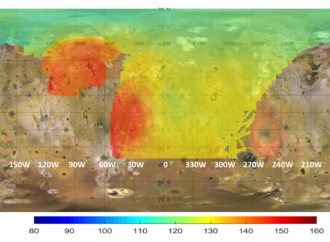
This map represents data captured by the Microwave Radiometer (MWR) aboard NASA’s Juno spacecraft, indicating the heat rising just below the surface of Jupiter’s moon Io. While infrared instruments measure the temperature of the moon’s surface, the MWR’s lower frequency microwave channels (0.6 and 1.25 gigahertz) can penetrate 6 to 20 feet (2 to 6
READ MORE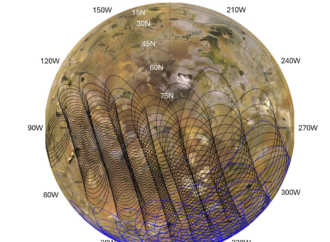
This graphic illustrates the areas of Jupiter’s moon Io sampled by the Microwave Radiometer (MWR) instrument aboard NASA’s Juno spacecraft during two close flybys. The superimposed black lines show the instrument’s footprints during Perijove 57 on December 30, 2023, when the spacecraft primarily mapped the Northern Hemisphere. The blue lines represent Perijove 58 on February
READ MORE