Half a century ago, biochemists Georges Köhler and César Milstein kicked off a revolution in medicine. Their 1975 paper described how to mass-produce monoclonal antibodies: proteins that can be designed to recognize and bind specifically to almost any protein target1. These antibodies have since become a workhorse of biological research and the basis of blockbuster
Half a century ago, biochemists Georges Köhler and César Milstein kicked off a revolution in medicine. Their 1975 paper described how to mass-produce monoclonal antibodies: proteins that can be designed to recognize and bind specifically to almost any protein target1. These antibodies have since become a workhorse of biological research and the basis of blockbuster treatments for cancer, autoimmune conditions and infectious diseases. “Such cultures could be valuable for medical and industrial use,” the paper concludes.

The most-cited papers of the twenty-first century
That was right on the money. The influence of Köhler and Milstein’s paper in academia and industry is clear from its citations. It has been cited in more than 17,000 academic papers, putting it in the world’s top 1,000 most-cited studies.
Even more strikingly, with more than 13,000 mentions in patent applications, it ranks fifth among the scholarly articles that are most cited in patents — that is, the documents filed to gain legal protection for potentially money-making inventions.
Patent citations are one way to examine how academic research flows into commercial innovation. So, with an eye to getting a sense of the most industrially influential work, Nature has charted the scholarly papers that patents cite the most.
One might expect this list to be a parade of commercially important research. Köhler and Milstein’s paper is one such example: it netted them a share of the 1984 Nobel Prize in Physiology or Medicine, and other Nobel-prizewinning work appears in the list.
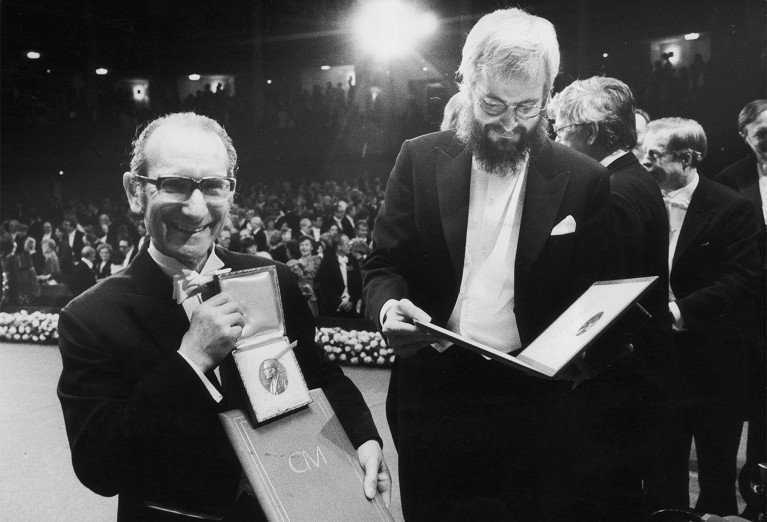
César Milstein (left) and Georges Köhler received a share of the Nobel Prize in Physiology or Medicine in 1984.Borje Thuresson/Keystone/Getty
In fact, the list of top-cited studies in patents presents some surprising results, because of the vagaries of the patenting process and its conventions about what to reference. Although many papers have obvious importance, some studies in the list are rarely mentioned in academic journals, and even their authors don’t know why they are cited in so many patents.
“Causality in knowledge flows between scholarly work and patents is not a simple matter,” says Richard Jefferson, the founder and former director of The Lens Project, a free database of patents and scholarly works that was one source for Nature’s analysis. (Jefferson is chief scientist at the non-profit social enterprise Cambia in Canberra, Australia.)
Nonetheless, the exercise does reveal insights about the influence of academia on industry: not least, that the majority of papers most cited in patents are the product of publicly funded research.
That was the case for Köhler and Milstein’s study, which was supported by the Medical Research Council (MRC) Laboratory of Molecular Biology (LMB) in Cambridge, UK, where the researchers worked. Ironically, however, their invention was not patented in the United Kingdom, notes Arthur Lesk, a biochemist at Pennsylvania State University in University Park, who was working at the LMB at the time. Milstein “spent a lot of time” trying to persuade the MRC to pursue a patent, Lesk says. “They refused.” In the end, it was US researchers who patented the work and took the royalties.
Why patents cite papers
References to scholarly papers in patents serve a different function from those in academic research, explains economist Adam Jaffe, a specialist in technological innovation who has retired from Brandeis University in Waltham, Massachusetts.
To gain a patent, an inventor must show, among other things, that their work is genuinely new and wouldn’t be ‘obvious’ given the state of existing research. So it is a legal requirement for the inventor — or the lawyers or technology-transfer specialists who file the patent application — to list studies and patents that summarize the current state of the art. And a patent examiner, who decides whether to grant or reject an application, can add more references to the list.
This produces an ordered list of references, sometimes known as the front page of the patent, that should be a paper trail of relevant sources of knowledge leading up to an invention (see ‘How patents cite papers’). But it means that well-written reviews or commentaries that are not themselves breakthrough works can feature heavily.
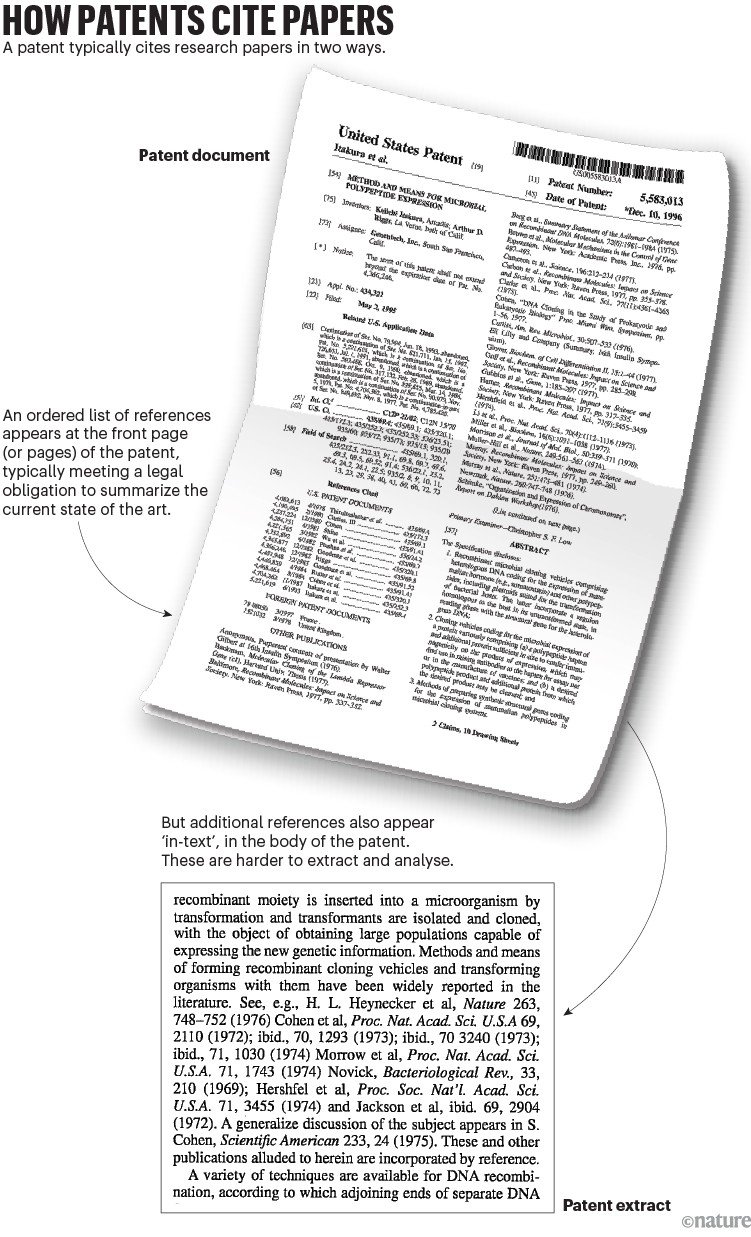
Source: Patent no. US 5583013 A
For instance, second in the list of top-cited works in the front pages of patents, according to The Lens, is a 1977 review2 by researchers at the multinational drug firm Pfizer, on how to convert drugs into their salt forms. As of March, the review had more than 16,000 references in patents, but only a few hundred academic mentions.
More confusingly, a 1994 review3 about antibodies, by biochemist Peter Colman, has just 5 citations in academic papers, but a whopping 4,467 mentions in patents, according to The Lens — placing it 30th on the most-cited list. “I have no solid explanation for this puzzling statistic,” says Colman, who is retired and most recently worked at the Walter and Eliza Hall Institute of Medical Research (WEHI) in Melbourne, Australia.
The paper explains how changing an amino acid in an antibody’s protein sequence can have unpredictable effects on the antibody’s function. That is an important point for patent examiners, suggests Kevin Noonan, a patent lawyer and partner at the law firm MBHB in Chicago, Illinois. Applicants used to be able to claim legal protections around not just the antibodies they disclosed in a patent, but also many variants of that structure. But as it became understood that small variations can change function, examiners now tend to allow for only narrow legal protection around precisely what’s disclosed. Colman’s article became a favoured reference for examiners to add to patents, Nature’s analysis suggests.
Such quirks mean it can be dangerous to draw inferences about the commercial influence of individual papers that are heavily cited in patents, notes Jaffe. However, large-scale analyses of papers cited in patents can pull out a meaningful signal from the noise. For instance, Jaffe worked with The Lens team to introduce a ranking of the influence of academic research on innovation, called In4M. In a 2018 study, the team used the ranking to report that the Scripps Research Institute in La Jolla, California (now Scripps Research), had the most patent citations per article, when normalized for research discipline4.
The dominance of antibodies
Most of the top-cited scholarly articles in patents relate to the life sciences. This reflects not just the enormous size of the biotechnology industry, but also the fact that some fields are simply more prone to citing research articles in patents than are others, Jaffe says. In a list of the top 100 cited works, downloaded from The Lens, more than a dozen of the papers relate to methods for making or modifying antibodies, which sprung up after Köhler and Milstein’s work (see ‘The papers most cited in patents — front pages’ and Supplementary information). Lesk co-authored a 1987 paper5 that is seventh on the list; he and his colleagues’ guidelines help scientists to modify the sequence of small portions of an antibody so that it binds more strongly to a target protein.
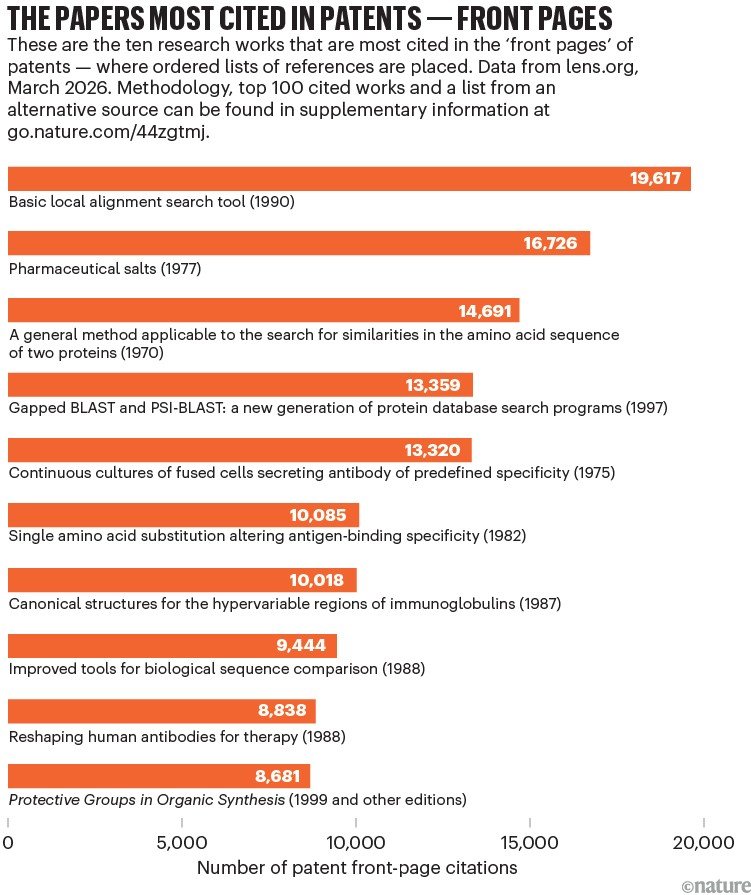
Source: lens.org
It took decades to resolve other barriers to making antibodies usable as drugs. Köhler and Milstein used antibody-producing cells from mice, and papers that were the first to ‘humanize’ an antibody — by grafting the portion of a mouse antibody that recognizes its protein target onto a human antibody backbone — are ninth and 11th on the list6,7. Two papers that report how to create a simpler version of an antibody, known as a single-chain antibody, are ranked 12th and 16th8,9. And two 1991 papers that describe how to screen large amounts of antibodies to select for the ones that bind best to a target are 20th and 21st10,11.
This screening technique, called phage display, won biochemist Greg Winter, who was also at the MRC LMB, a share of the 2018 Nobel Prize in Chemistry. “At the time, of course, I didn’t know exactly how far therapeutic antibodies would go,” says Winter, who is now retired. He founded the company that developed Humira (adalimumab), an injectable antibody-based drug to treat inflammatory diseases, which has earned more than US$200 billion in sales; he has also in the past earned royalties from the anti-cancer antibody Keytruda (pembrolizumab), which is the world’s top-selling drug. Winter is one of the most-mentioned authors in The Lens top-100 list; he is a co-author of 9 of the papers.
Today, says Paul Carter, a biochemist at Genentech in South San Francisco, California, there are more than 200 distinct approved drugs, 400,000 papers and 16,000 patents that rely on antibodies. One of the drugs is his own invention: the anti-cancer treatment now sold as Herceptin entered the scientific literature in 1992, in a paper12 that is 41st on the list.
“It’s stunning,” says Carter. “There aren’t many technologies which are so profoundly impactful in a relatively short period of time.”
Comparing sequences
Scattered through The Lens list are eight papers that describe methods for comparing DNA or protein sequences. Such analyses are crucial for demonstrating whether a particular protein or piece of DNA constitutes a new discovery, as well as for tracing its evolutionary history and providing clues to its function.
The 1990 publication13 of a software tool for comparing such sequences, the Basic Local Alignment Search Tool (BLAST), is the most frequently cited paper in the front pages of patents — and is also among the top-cited papers in academic research.

These are the most-cited research papers of all time
Users feed in a sequence and BLAST rapidly fishes out similar sequences from genetic databases and aligns them with the query. “It’s like Google for DNA and protein,” says Stephen Altschul, a bioinformatician who has retired from the US National Institutes of Health in Bethesda, Maryland, and a co-author of the paper. Two other papers for comparing sequences, including a 1997 update to BLAST, are third and fourth on the list14,15.
Molecular biology has come a long way since early versions of BLAST were shipped out to users on CD-ROM, says Altschul. In 1990, the biotechnology industry was young but on the verge of explosion, and companies had already started to patent naturally occurring genes — a practice that was later abolished by the US Supreme Court. “It was clear there was a gold rush,” says David Lipman, another author of the early BLAST papers and the former director of the US National Center for Biotechnology Information in Bethesda.
By 2023, the global market for drugs based on biological molecules, including antibodies, had climbed above $400 billion. Amid all the changes, BLAST remained an important tool for characterizing DNA and proteins. “It’s still being used over 35 years later,” says Altschul. “I’m happy about that.”
Plant science and ‘in-text’ citations
The front page isn’t the only place where papers are cited in patents. Mentions of scientific works are also scattered through a patent’s body text — known as in-text citations. These tend to be added by inventors themselves: sometimes to explain their inspiration, or as part of disclosures that enable a skilled reader to reproduce the patent’s methods. But they are usually embedded in sentences rather than in an ordered reference list, and are sometimes alluded to cryptically (“Smith 1992” or “Palmer and Watkins”, for example), so are hard to analyse.
In the past decade, however, researchers have used machine-learning algorithms to fish out many (although not all) of these cryptic references, and to link them to papers. One such project, Reliance on Science, is led by Matt Marx at Cornell University in Ithaca, New York, who studies entrepreneurship and innovation, and computer scientist Aaron Fuegi at Boston University in Massachusetts. They found that just over 30% of scientific citations appear only in the body text of patents; these would be missed by just examining the front-page references16.
Not considering in-text citations “can result in a substantial understatement of the commercial impact of academic science”, Marx and Fuegi noted in a 2021 paper16. For instance, they referred to a previous study that suggested 31% of all US National Institutes of Health grants had some commercial impact, as measured by studying how many scholarly articles listing such grants are mentioned in patents. But the Reliance on Science data push this up to 44%.
For this article, Nature re-analysed a publicly shared Reliance on Science data set that goes up to 2023, producing lists to show the works most often mentioned overall in patents, and breaking that down by front-page and in-text citations. (A newer data set goes up to 2025, but contains references from US patent filings only.) Nature then compared the Reliance on Science list with that from The Lens.
The two data sources don’t give the same results because their source material and data-extraction methods differ. For instance, tens of thousands of references to various editions of a book first published in 1982, Molecular Cloning: A Laboratory Manual, mean that it tops the Reliance on Science list once all references to its editions are combined (see ‘The papers most cited in patents — including body text’ and Supplementary information). But it doesn’t appear high up in The Lens list, apparently because most of its mentions were not mapped to a scholarly-work record. Despite this, the sources mainly agree on the top-cited papers overall, with antibody research and biological software topping the lists. This is in part because popular work cited on the front page of patents also appears as in-text citations.
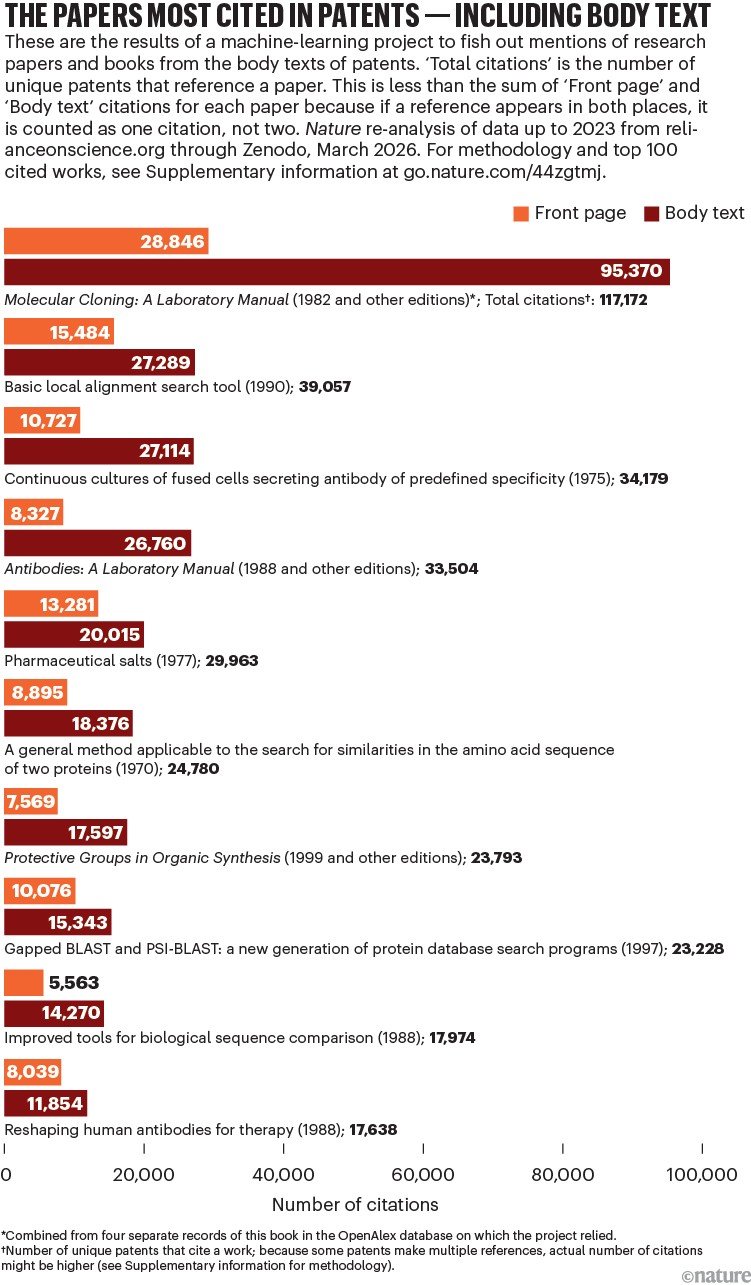
Source: Nature analysis/relianceonscience.org
Differences emerge lower down the lists, however. For instance, only two plant-biology papers make it to the list of top 100 papers mentioned in the front pages of patents. But including in-text citations pushes 28 plant papers into the Reliance on Science list. Some of them describe methods and concepts that are important for plant breeding or making transgenic plants. Others describe discoveries in plant metabolism, or mechanisms of disease resistance.
The popularity of such papers among patent filers does not surprise Chris Holly, a patent attorney and partner at the international law firm Cooley in San Francisco, California. Agriculture generates a steady stream of patents, he notes. As an example, he points to patents involving the gene-editing technique CRISPR. Although the method’s potential medical applications garner more media attention than its agricultural uses do, the firm with the most US patents on CRISPR technology is Corteva Agriscience in Indianapolis, Indiana (a spin-off formed after the merger of the giant chemical firms Dow and DuPont).
Noonan and Holly both suggest that plant-science papers that lay out biological techniques will often be cited to point readers to key methods in the field. That, perhaps, is why they turn up so frequently in a patent’s body text.
Check back often for more exciting news!