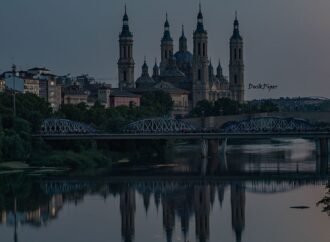
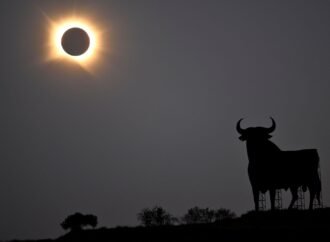
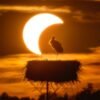
Explanation: On August 12th, 2026, the Moon totally eclipsed the Sun and cast its shadow across Siberia, Greenland, Iceland, Spain, and Portugal. Today’s image features two total solar eclipses viewed from Zaragoza, Spain, one over the Cathedral-Basilica of Our Lady of the Pillar and the other reflecting in the Ebro River. For a few moments, Spain saw its first major total solar eclipse since
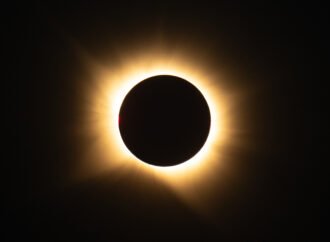
Regions such as Galicia, Asturias, Castile and León, Madrid, Aragon, Catalonia, the Valencian Community, and the Balearic Islands experienced the path of totality, while the rest of the country saw a partial eclipse. The solar corona glows as the moon completely blocks the sun during the totality phase, as seen from San Asensio in the
A total solar eclipse is seen from San Millán de los Caballeros, Spain, Wednesday, Aug. 12, 2026. A total solar eclipse – the Moon passing between the Sun and Earth, completely blocking the face of the Sun – swept across parts of Greenland, Iceland, northern Russia, the Atlantic Ocean, Spain, and a small corner of
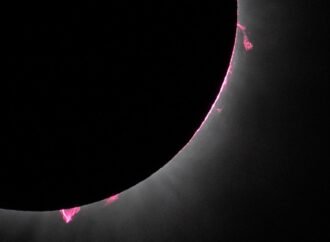
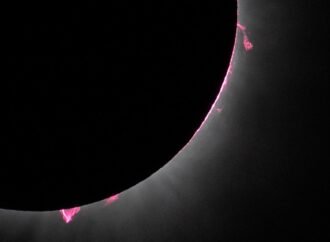
Hello Nature readers, would you like to get this Briefing in your inbox free every day? Sign up here. Solar prominences protruding from the Sun’s corona during a total solar eclipse in Dallas in 2024.Credit: NASA/Keegan Barber On 12 August, researchers will get roughly two minutes to study the Sun’s outermost layer — the solar
The horse racing meeting at Ffos Las in South Wales will begin about two hours earlier on Wednesday because of the solar eclipse. The UK and parts of Europe are set to experience the most significant solar eclipse in nearly three decades, which is set to begin shortly after 18:00 BST. At other sporting events,
Solar prominences protruding from the Sun’s corona during a total solar eclipse in Dallas in 2024.Credit: NASA/Keegan Barber When the Moon blocks the Sun over Greenland, Iceland and Spain on 12 August, researchers will get roughly two minutes to study the solar corona, the Sun’s outermost layer, which is only visible to the naked eye