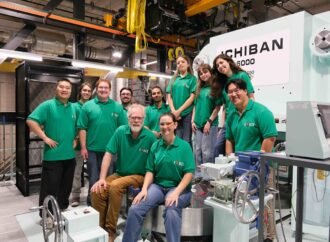
The NASA Science Mission Directorate (SMD) Community of Practice for Education (SCoPE) – part of the NASA Science Activation (SciAct) Program portfolio – enables Earth and Space Science and Engineering Subject Matter Experts (SMEs) – especially NASA-funded SMEs – to efficiently and effectively share their science with support from SciAct education experts. In Summer 2026,
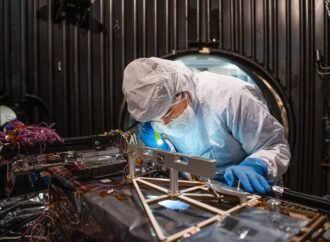
NASA has declared “wrenches down” on the first completed payload designed for Artemis astronauts to deploy on the Moon’s surface. Engineers working on NASA’s Lunar Environment Monitoring Station, or LEMS, have completed hardware development and testing and the payload is ready for its permanent home near the lunar South Pole. With the hardware complete, LEMS
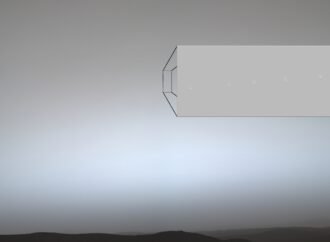
Earth and the Martian moon Phobos dance together in a series of images recently acquired by NASA’s Perseverance Mars rover. Earth appears as a point of light in the Martian sky, disappearing behind the crescent of Phobos, the larger of Mars’ two moons. This is the first time humanity has captured from the surface of
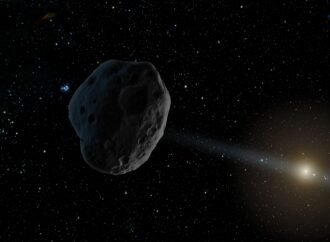
New research led by scientists at NASA’s Jet Propulsion Laboratory in Southern California has revealed the identity of a puzzling near-Earth object by precisely tracking its movement through space and using powerful observatories that image faint celestial objects. This object has a split personality: Previous images had revealed no obvious comet-like activity, suggesting it could
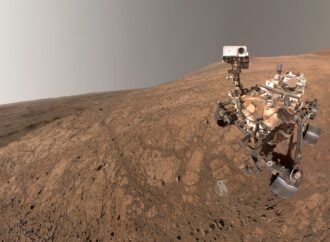
NASA’s Perseverance Mars rover has discovered evidence that a 245-foot (75-meter-thick) pile of ancient rock on the rim of Jezero Crater was built by repeated asteroid impacts. This sequence of layered bedrock, dubbed the “Broom Point Member” by the rover’s science team, is likely more than 3.9 billion years old, making it some of the
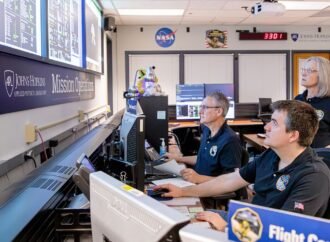
After its longest hibernation period of nearly a year, NASA’s New Horizons spacecraft has emerged in good health and is ready to begin transmitting scientific data collected in the distant Kuiper Belt, far beyond Pluto. On June 23, flight controllers at the Johns Hopkins Applied Physics Laboratory (APL) in Laurel, Maryland, confirmed that New Horizons,